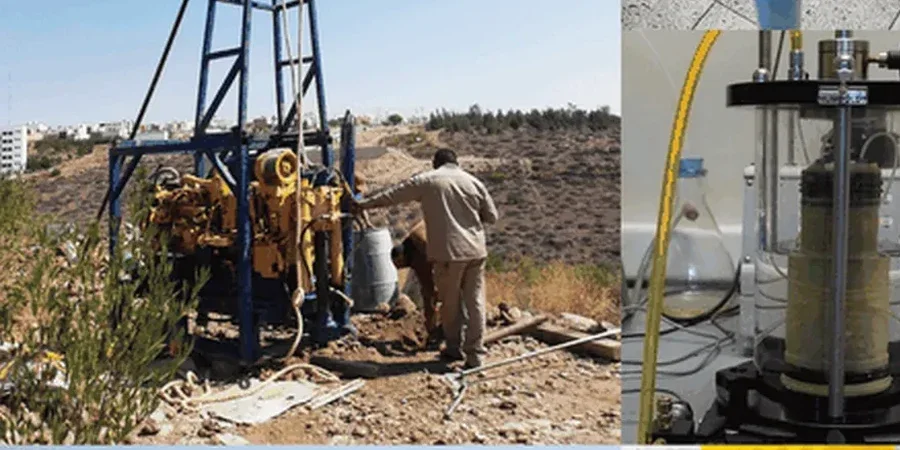
Around Nanaimo, the ground can shift its story from one lot to the next. You might hit hard sandstone near Departure Bay and, a few blocks inland toward the hospital, find yourself in a pocket of soft marine clay that wasn't on any preliminary map. A soil mechanics study bridges that gap between what the surface suggests and what the foundation will actually have to carry. We look at strength, compressibility, and how water moves through the strata, because on an island where winter rain is a given, drainage behavior matters as much as bearing capacity. For deeper sites where bedrock is within reach, pairing this analysis with spt drilling gives us the blow-count data needed to size footings with confidence, especially when the till layer is thinner than expected.
Good soil mechanics isn't about finding a number you can use — it's about understanding which number actually applies to your specific piece of ground in Nanaimo.
Technical details of the service in Nanaimo
Live process video
Risks and considerations in Nanaimo
We reviewed a commercial site near the Nanaimo Parkway where the owner had already commissioned a basic report from a non-local firm. The report assumed a homogeneous silty sand profile and recommended a 150 kPa allowable bearing pressure. When we ran our own soil mechanics study, we found a lens of soft clay at 2.8 meters depth that the earlier investigation had completely missed, because the boreholes simply hadn't gone deep enough. That clay lens would have settled differentially under the proposed slab, cracking partition walls within the first five years. The fix wasn't complicated once we knew about it — a deeper excavation and a properly engineered granular pad — but catching it late would have meant a six-figure repair. Nanaimo's patchy Quaternary stratigraphy doesn't forgive shortcuts.
Our services
Our soil mechanics study in Nanaimo covers the full chain from field sampling to design-ready parameters. Every project gets a lab program that matches the actual ground conditions we encounter, not a pre-printed checklist.
Laboratory Testing Suite
Triaxial shear, consolidation, Atterberg limits, and grain-size analysis run in our ISO 17025-accredited lab. We select the test method that fits your soil type, not the other way around.
Geotechnical Interpretative Report
A plain-language document that gives your structural engineer the bearing capacity, settlement curves, and lateral earth pressures they need — with clear commentary on what's conservative and what isn't.
Quick answers
What does a soil mechanics study in Nanaimo typically cost?
For most residential and light commercial projects in the Nanaimo area, a complete soil mechanics study — including field sampling, laboratory testing, and the interpretative report — falls in the range of CA$4,770 to CA$7,930. The final number depends on how many boreholes or test pits are needed, the depth of investigation, and the lab tests selected. A straightforward single-family lot on competent till will sit at the lower end; a sloped parcel with complex stratigraphy requiring triaxial and consolidation testing will push toward the upper end.
How is a soil mechanics study different from a basic geotechnical investigation?
A basic investigation might stop at soil classification and a generic bearing capacity table. A proper soil mechanics study goes further: it quantifies how the soil behaves under load, how much it will settle over time, and how pore water pressure changes during construction and operation. It gives your engineer the deformation parameters — not just a bearing number — so they can design foundations that really fit the ground in Nanaimo.
How long does the lab testing take once samples are collected?
Standard classification tests (grain size, Atterberg limits) can be turned around in five to seven business days. Consolidation and triaxial tests need more time — typically two to three weeks — because they involve staged loading and pore pressure measurement. We always sequence the program so your structural engineer gets preliminary parameters early while the longer-duration tests finish in the background.
Do you handle steep sites near Nanaimo's waterfront bluffs?
Yes, and those are precisely the sites where a detailed soil mechanics study pays for itself. Waterfront bluffs along Nanaimo's coastline often involve fractured sandstone and overlying colluvium. We measure shear strength parameters that feed directly into slope stability analysis, so the foundation design works with the natural grade instead of fighting it.