The ground conditions between downtown Nanaimo and the newer developments south toward Chase River can feel like two different worlds. Near the harbour, you hit massive sandstone of the Cretaceous Nanaimo Group, competent but jointed. Just a few kilometers inland, the glacial till and marine clays demand a completely different anchoring philosophy. A passive anchor grouted into bedrock behaves nothing like a tensioned active tendon in overconsolidated silt. Our field team has instrumented anchors across this city’s geological transitions, from the Departure Bay formations to the slopes above the Nanaimo River. The load transfer mechanism changes with the stratigraphy, and we design for that reality. When the soil profile is uncertain, we often pair the anchor scheme with a CPT test to map the soft zones before finalizing the free length and bond zone geometry.
A properly designed anchor system in Nanaimo’s mixed geology transforms a retaining structure from a rigid element into a load-sharing mechanism that works with the ground, not against it.
Technical details of the service in Nanaimo
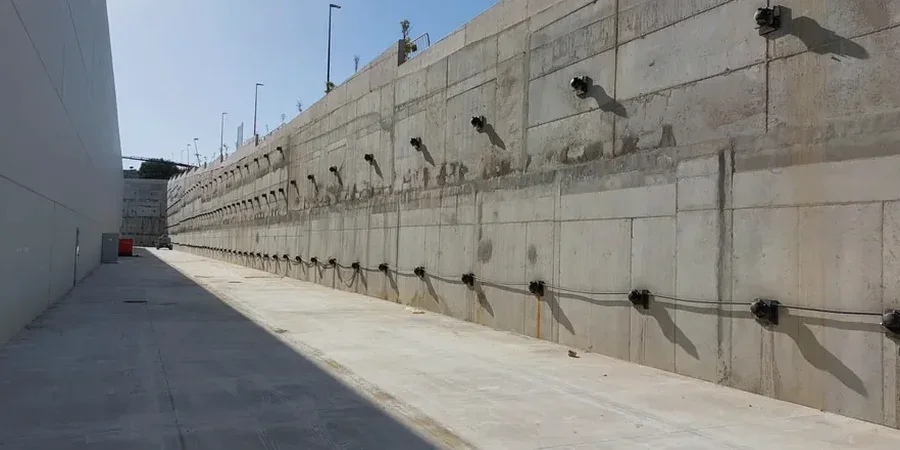
Risks and considerations in Nanaimo
The Cretaceous Nanaimo Group bedrock under the city is interbedded sandstone, siltstone, and shale—competent but prone to differential weathering. Where the shale layers outcrop on slopes, passive rock anchors can lose capacity over time if the bond zone intersects a weathered seam. In the Lantzville and Hammond Bay areas, the Vashon Drift till contains cobbles and boulders that deflect the drill and create shadow zones in the grout. That risk requires careful drilling logs and, often, water pressure testing to confirm the integrity of the bond length. The biggest liability in Nanaimo anchor work is assuming uniform ground. A single borehole at the street level can miss a 3-meter organic lens or an artesian layer that changes the effective stress regime. We mitigate this by requiring a minimum of two investigation points per anchored wall line and by staging the anchor installation to allow for design adjustments based on the first row of production drilling.
Our services
We deliver anchor design operations tailored to the specific geological and regulatory context of Nanaimo. Our work spans temporary excavation support and permanent slope stabilization, always grounded in site-specific investigation.
Temporary shoring anchor design
Design of active tieback anchors for braced excavations in urban Nanaimo lots, including staged stressing sequences and proof testing protocols per CSA A23.3.
Permanent slope stabilization with passive anchors
Passive bar anchors and soil nails for long-term retention on the steep slopes of the Nanaimo River valley and along the Island Highway corridor.
Anchor load testing and verification
Performance and proof testing with calibrated jacks and digital load cells, including extended creep monitoring for anchors installed in the city’s overconsolidated tills.
Quick answers
How much does anchor design for a retaining wall in Nanaimo typically cost?
The engineering design fee for an anchored wall system in Nanaimo generally ranges from CA$1,630 to CA$5,000, depending on the number of anchor rows, the complexity of the soil profile, and the required testing program. This covers the design calculations, stamped drawings, and the load testing specification. The cost does not include the anchor installation itself or the drilling subcontract.
What is the difference between active and passive anchors in a shoring context?
An active anchor is post-tensioned after installation—we apply a lock-off load, typically 70–80% of the design load, to actively pre-compress the ground and limit wall deflections before excavation proceeds. A passive anchor, by contrast, only develops resistance when the ground moves and loads it. In Nanaimo’s sensitive clay zones, active anchors are often the better choice to control settlement behind the wall, while passive bar anchors work well for rock-cut stabilization where some relaxation is acceptable.
What site investigation is needed before designing anchors in Nanaimo?
For any anchored system, we require at minimum two boreholes or a combination of boreholes and CPT soundings along the wall alignment to capture lateral variability in the Nanaimo Group bedrock or glacial drift. Key parameters include the undrained shear strength of clays, the relative density of granular layers, and the groundwater level—especially important in the coastal areas where tidal influence can affect grout set and bond development.