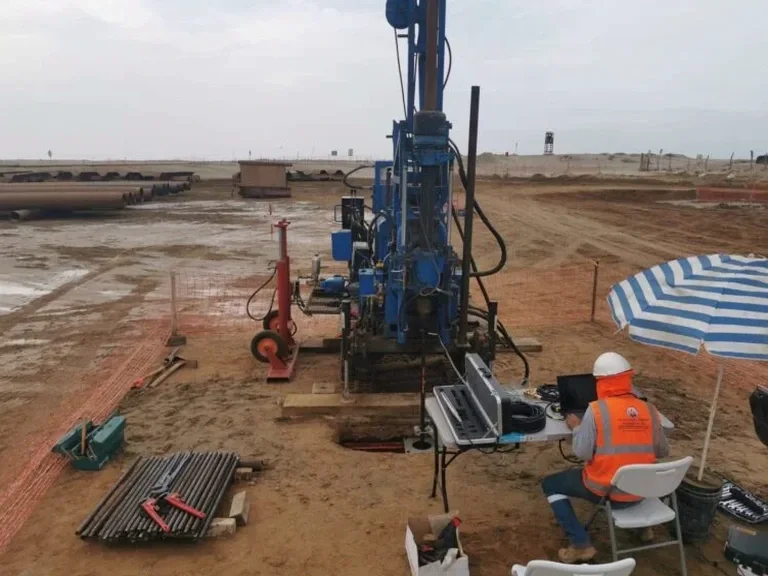
A mistake we see too often in Nanaimo: assuming a few SPT blows can fully characterize the complex glaciomarine deposits that dominate this coastline. The drumlin fields and raised marine terraces south of Departure Bay hide thin, sensitive clay seams and interbedded sand lenses that a split-spoon sampler simply cannot resolve. Relying solely on disturbed samples in these conditions leads to conservative designs that inflate foundation costs—or worse, overlooks a compressible layer that causes differential settlement later. We bring the CPT rig onto site to get a continuous, real-time profile of tip resistance and sleeve friction, because in a city where the bedrock surface can plunge 30 meters beneath soft estuarine fill near the Nanaimo River estuary, every centimeter of stratigraphy matters. When the data demands it, we complement the investigation with test pits to visually confirm the soil fabric at critical depths, but the CPT remains our first tool for mapping the subsurface without gaps.
Continuous CPT data in Nanaimo’s glaciomarine sequences reveals thin soft layers that conventional SPT sampling misses—and those layers often control settlement behavior.
Technical details of the service in Nanaimo
Live process video
Risks and considerations in Nanaimo
The risk profile in Nanaimo shifts dramatically between the dry summer months and the rainy season from October through March, when perched groundwater in the sandstone and conglomerate colluvium of the Mount Benson foothills saturates the overlying silts. The CPT’s pore pressure transducer reads this directly—a rising u₂ signal during penetration in a clay layer warns us of low effective stress and potential instability before any excavation begins. A more insidious hazard is the presence of sensitive, low-plasticity silt near the Millstone River corridor: these soils lose significant strength when remolded, and a standard SPT would completely destroy their structure before testing. The CPT measures in-situ strength without disturbing the soil fabric, giving us a true undrained shear strength profile that we can plug directly into slope stability models for the steep grades common along Nanaimo Lakes Road. Ignoring this sensitivity has led to rotational slides during excavation, particularly where old coal mine entries create preferential drainage paths that soften the surrounding till over decades. For sites with high silt content, we often correlate the CPT data with grain size laboratory analysis on companion soil samples to refine the soil behavior type classification.
Our services
Our CPT program in Nanaimo adapts to the site’s access constraints—we operate a truck-mounted 20-ton rig for standard lots and a portable crawler unit for the tight slopes above Departure Bay. Each investigation includes real-time stratigraphic logging and a final report with interpreted geotechnical parameters ready for foundation design.
Standard CPTu sounding (single location)
One continuous piezocone sounding to refusal or 30 m depth, with qc, fs, and u₂ logs at 20 mm intervals. Includes soil behavior type (SBTn) chart, undrained shear strength profile, and preliminary bearing capacity estimate for shallow footings.
Seismic CPT (SCPTu) for site class determination
Adds a downhole geophone array to measure shear wave velocity (Vs) every meter. Essential for NBCC seismic site classification in Nanaimo’s high-seismicity zone (near the Cascadia subduction interface), providing Vs30 and site class directly from in-situ measurements.
Dissipation testing and consolidation parameters
At client-specified depths, we stop penetration and record pore pressure decay over time. This yields in-situ estimates of the horizontal coefficient of consolidation (ch), which controls settlement rate predictions for compressible clays under embankments or large mats.
Quick answers
What is the typical cost range for a CPT sounding in Nanaimo?
For a standard CPTu sounding in the Nanaimo area, the cost typically falls between CA$230 and CA$300 per meter, depending on required depth, access conditions, and whether additional modules like seismic (SCPTu) or dissipation tests are specified. A single 20-meter sounding with basic parameters generally totals CA$4,600–CA$6,000 plus mobilization, which varies with site location relative to our dispatch point on the Island.
How does the CPT handle Nanaimo's dense glacial till?
The Vashon till that underlies much of Nanaimo can develop very high tip resistance—often exceeding 30 MPa in the dense basal member. Our 20-ton rig reaches refusal when qc surpasses approximately 50 MPa or when the cone encounters large cobbles. In those cases, we note the refusal depth and recommend a complementary approach: pre-drilling through the till with a small-diameter auger or switching to a stone columns investigation path if ground improvement is being considered. The CPT log up to refusal still provides a continuous strength profile of the overlying softer units.
Can CPT detect old coal mine workings beneath Nanaimo?
Directly detecting open voids with the CPT cone is difficult—the tip will encounter a sudden drop in resistance but the signal can be ambiguous if the void is partially collapsed or filled with loose debris. What the CPT does very well is identify the disturbed ground above and around old workings: elevated pore pressures from altered drainage, zones of very low sleeve friction indicating remolded soil, and abrupt changes in soil behavior type that suggest backfilled material. We always cross-reference CPT results with historical mining maps from the Nanaimo Community Archives and, when voids are suspected, recommend supplementary seismic refraction surveys to image velocity anomalies.
What is the difference between CPT and SPT for foundation design in Nanaimo?
The key difference is continuity. An SPT provides a disturbed sample and N-value at 1.5-meter intervals—valuable for visual classification but prone to missing thin soft layers. The CPT produces a near-continuous (20 mm spacing) record of mechanical response, so a 100 mm thick silt seam between sand layers shows up clearly in the qc and u₂ traces. In Nanaimo’s interbedded glaciomarine deposits, that thin seam can control the drained bearing capacity or act as a drainage boundary during consolidation. We use both tools together: CPT for the detailed stratigraphic framework, and targeted SPT drilling at depths where we need a physical sample for laboratory testing.
How soon do you deliver the CPT report after fieldwork?
For a standard CPTu sounding, we typically carry out a preliminary digital log (qc, fs, u₂ versus depth) within 24 hours of site completion so the design team can begin foundation analysis immediately. The final interpreted report—including soil behavior type classification, undrained shear strength, effective friction angle estimates, and consolidation parameters from dissipation tests—follows within five business days. For seismic CPT (SCPTu) data, the Vs profile and site class determination may add two additional days due to signal processing requirements.