Nanaimo sits on a complex geology of Cretaceous sandstone and conglomerate of the Nanaimo Group, but the urban and waterfront zones are underlain by loose Quaternary granular deposits and marine silts with groundwater often within 2 meters of the surface. In these conditions, vibrocompaction design becomes the primary solution for mitigating seismic settlement in a city where the peak ground acceleration can reach 0.4g according to the NBCC 2020 seismic hazard data. We approach each project by first characterizing the grain-size distribution and relative density of the deposit, because effective densification requires a fines content below 15% and an initial SPT N-value under 15 blows. Without this upfront analysis, the vibrator energy simply dissipates without achieving the target density. In coarser alluvial fans near the Nanaimo River, we combine the vibrocompaction grid with a CPT verification program to confirm that the post-treatment cone resistance exceeds the design threshold, typically 10 MPa for non-liquefiable performance.
A well-designed vibrocompaction grid in Nanaimo's loose sands can reduce post-liquefaction settlement by over 70% when verified with CPT before and after treatment.
Technical details of the service in Nanaimo
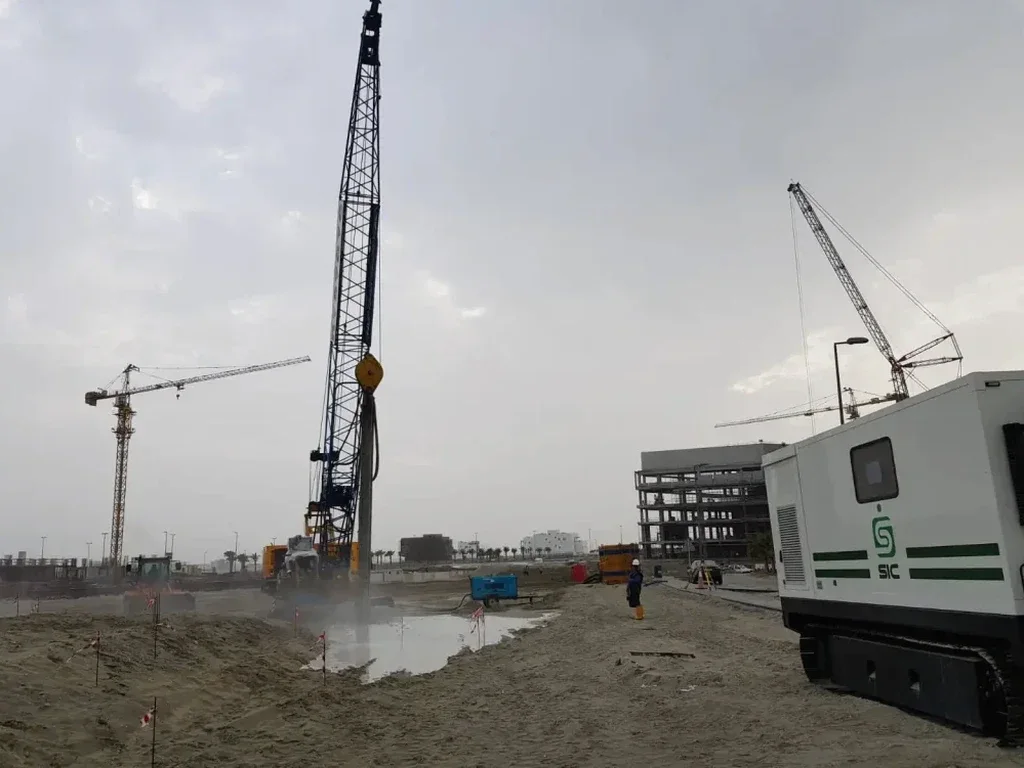
Live process video
Risks and considerations in Nanaimo
NBCC 2020 classifies much of Nanaimo's waterfront as Site Class D or E, which amplifies spectral acceleration and triggers mandatory liquefaction assessment under CSA A23.3. The primary risk in a poorly executed vibrocompaction design is under-compensation—visible only when post-treatment CPT soundings show cone resistance below the 10 MPa threshold in scattered pockets between compaction points. These untreated lenses can still liquefy and cause differential settlement that fractures slab-on-grade foundations and severs utility connections. A secondary risk specific to Nanaimo is the presence of buried organic silt lenses from the Nanaimo River estuary; these compressible inclusions do not densify under vibration and require excavation or a hybrid approach with stone columns. Our design protocol includes a pre-treatment resistivity survey to flag such soft zones before the vibrator enters the site, avoiding costly rework and schedule delays.
Our services
Our vibrocompaction design operations in Nanaimo cover the full project lifecycle, from feasibility assessment through post-treatment verification. Each phase is tailored to the specific granular deposit and the structural performance requirements of the overlying building.
Feasibility and Desktop Study
Review of existing geotechnical reports, grain-size curves, and groundwater data to confirm vibrocompaction applicability. Includes preliminary grid design and estimated settlement reduction for the Nanaimo site class.
Trial Compaction and Production Design
On-site trial panel with variable spacing, calibrated to achieve 70-85% relative density. Production design includes vibrator type selection, lift thickness, and real-time quality control parameters.
Post-Treatment CPT Verification
Cone penetration testing on the production grid to confirm that qc values exceed the design threshold. Statistical analysis of all soundings to demonstrate compliance with the NBCC liquefaction resistance criteria.
Quick answers
What soil types in Nanaimo are suitable for vibrocompaction?
Vibrocompaction works best in clean sands and silty sands with fines content below 15% passing the #200 sieve. The loose Quaternary alluvial sands along the Nanaimo River and the granular fill at the waterfront are ideal candidates. Soils with more than 20% fines or significant organic content—common in the estuary zones—do not respond to vibration and require alternative methods like stone columns.
How much does vibrocompaction design and execution cost in Nanaimo?
The total investment for vibrocompaction in Nanaimo typically ranges from CA$1,710 to CA$7,060, depending on the treatment depth, grid spacing, and the volume of material to be densified. A trial compaction panel and post-treatment CPT verification are included in this range, as they are essential for validating the design assumptions.
How do you verify that the ground improvement meets the NBCC requirements?
We perform CPT soundings at the centroid of each triangular compaction cell after treatment. The NBCC 2020 and CSA A23.3 require a minimum cone resistance—typically 10 MPa for a non-liquefiable classification at Nanaimo's design PGA of 0.40g. We compare pre- and post-treatment data statistically and issue a compliance report confirming the achieved relative density and settlement reduction.
Can vibrocompaction be used near existing buildings in downtown Nanaimo?
Yes, but with restrictions. The vibrator generates ground-borne vibrations that can disturb adjacent structures. We install seismographs at property lines and follow the CSA vibration limits—typically 5 mm/s peak particle velocity for heritage masonry buildings. In sensitive zones, we reduce the vibrator frequency or switch to a variable-frequency unit to stay within the safe threshold while still achieving the target density.
What is the typical treatment depth for vibrocompaction in Nanaimo?
Treatment depth depends on the depth to the Nanaimo Group bedrock or to a competent bearing layer. In the waterfront and river valley areas, loose deposits extend 8 to 20 meters. We routinely treat to 18–22 meters using a bottom-feed vibrator. The maximum practical depth with our V32 equipment is 25 meters, which reaches the Cretaceous sandstone in most of the city's developable land.