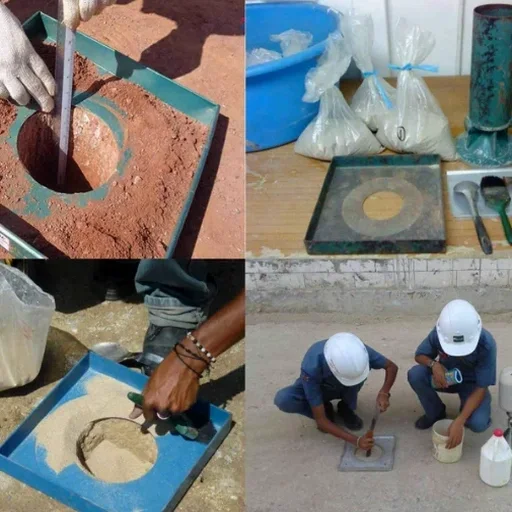
Nanaimo’s wet coastal winters don’t just slow down earthworks—they can ruin a lift of compacted fill overnight if the density isn’t verified. With the city spread across weathered sandstone benches and glacial till slopes, getting uniform compaction is a constant fight against moisture sensitivity and variable subgrade. The field density test, using the sand cone method, remains the most straightforward way to confirm that backfill around a foundation or bedding under a utility trench actually meets the project’s compaction spec. Our team runs these checks across Nanaimo—from new subdivisions near Departure Bay to commercial pads in the south-end industrial parks—bringing calibrated sand, cones, and a healthy respect for the rain that can skew a reading. When the subgrade conditions look marginal, we often pair the test with a soil grain-size analysis to understand whether the fill material itself is the problem, or if the compaction effort needs adjustment.
A density test is a snapshot of one lift at one moment. In a place where the water table can rise two feet overnight, that snapshot matters more than the spec implies.
Technical details of the service in Nanaimo
Risks and considerations in Nanaimo
Nanaimo’s development history left a patchwork of ground conditions that still affect compaction today. The downtown core sits on fill overlying the original shoreline and creek beds; older neighbourhoods near the hospital are built on cut-and-fill benches where the fill depth varies unpredictably. Even a few metres of lateral change can put you from competent compacted till into loose, wet reworked material. Skipping a field density test in these transition zones is a gamble—we have seen differential settlement crack a foundation wall within two years of construction, and the repair cost dwarfed what a day of testing would have run. The sand cone method gives you a defensible density number tied to a specific location and depth, which becomes critical documentation if a dispute arises with the municipality’s building inspection division or an adjacent property owner.
Our services
The sand cone test is one piece of a broader field and lab program. For a typical Nanaimo project—say a commercial building pad or a townhouse complex with underground parking—the following operations often run alongside the density work.
Field Density by Sand Cone
On-site determination of in-place dry density and percent compaction per ASTM D1556, covering structural fill, utility trench backfill, and subgrade preparation across Nanaimo.
Proctor Compaction Testing
Laboratory standard and modified Proctor curves (ASTM D698 / D1557) to establish the target moisture-density relationship for the specific fill material being used on your site.
Fill Material Suitability Assessment
Grain-size analysis and Atterberg limits to evaluate whether imported or on-site fill meets the gradation and plasticity requirements before compaction begins.
Quick answers
How much does a sand cone density test cost in Nanaimo?
For a standard call-out with multiple test locations around Nanaimo, a single field density test typically runs between CA$140 and CA$190, depending on travel distance and the number of tests required on the same visit. A full-day rate with several tests offers better value than booking one-off visits.
How soon after compaction can the test be performed?
The test can be performed immediately after the lift is compacted, provided the surface is stable and the equipment can be set up without disturbing the lift. On Nanaimo sites in wet weather, we may recommend waiting until free surface water drains off the test area, which usually takes less than an hour with proper grading.
What is the minimum number of tests required per lift?
The BC Building Code does not prescribe a fixed minimum, but industry practice in Nanaimo follows a guideline of at least one test per 500 m² per lift for structural fill, with additional tests near retaining walls, foundation edges, and utility penetrations where compaction is hardest to achieve consistently.
Can the sand cone method be used in coarse gravel or crushed rock?
It can, but with limitations. When the maximum particle size exceeds about 50 mm, the hole volume becomes less reliable because large particles distort the cavity shape. In those cases we often recommend a larger-volume replacement method or a plate load test to evaluate the fill’s stiffness directly instead of relying solely on density.