Most people don't think about soil plasticity until a footing cracks or a trench collapses. In Nanaimo, where pockets of marine clay sit right next to glacial till, knowing the liquid and plastic limits of your material isn't just lab paperwork—it's the difference between a straightforward build and a costly re-design. The city's geology shifts fast; a borehole at Departure Bay can look completely different from one up near the Nanaimo Parkway. Our lab runs Atterberg limits per ASTM D4318 so you know exactly how sensitive the soil is to moisture changes. When site conditions get complicated, we often pair this data with grain size analysis to build a full classification profile before structural decisions lock in.
A plasticity index above 20 in Nanaimo's marine clays almost always means you need moisture control during compaction.
Technical details of the service in Nanaimo
Live process video
Risks and considerations in Nanaimo
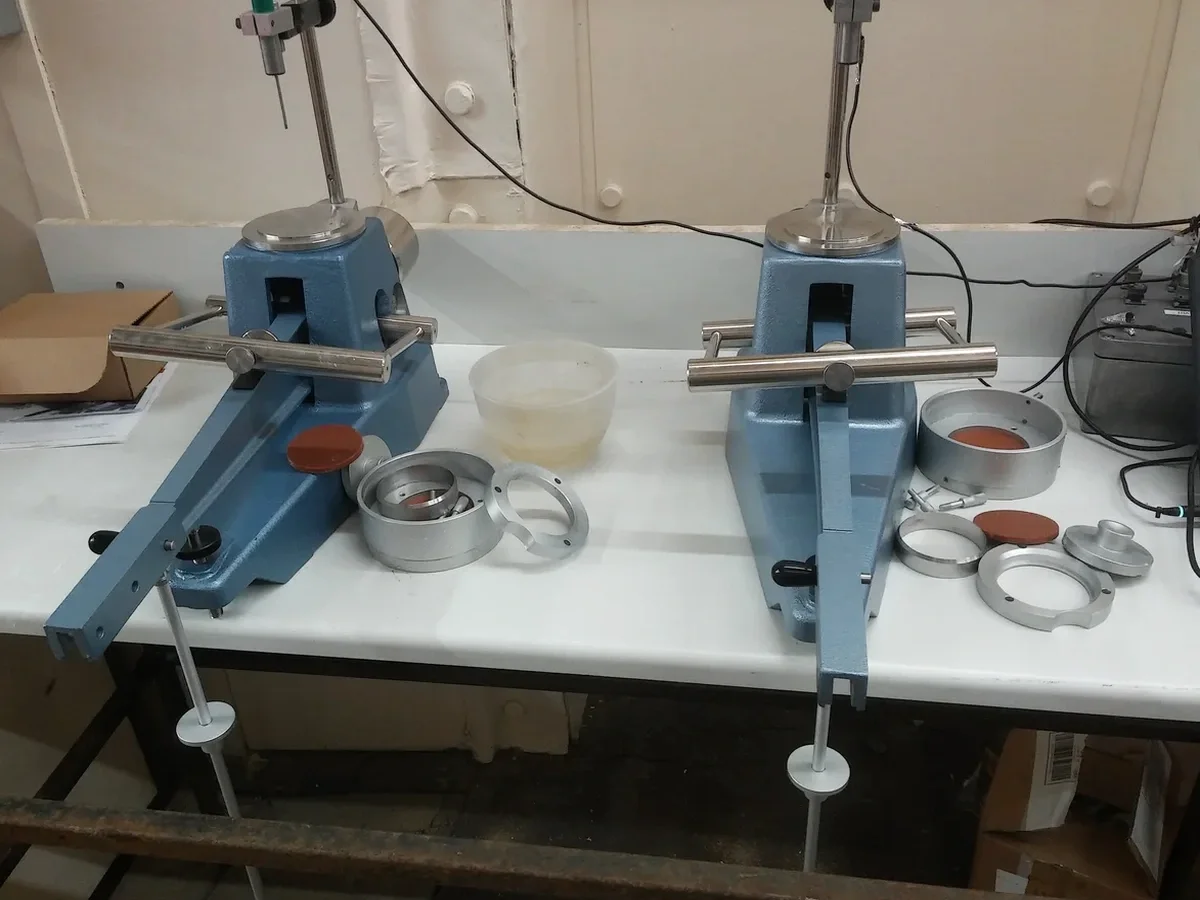
The Casagrande cup we use for liquid limit testing is surprisingly simple—a brass bowl on a rubber base, dropped 10 mm over and over while you count the blows. But the real skill isn't in running the machine; it's in preparing the sample so the results actually represent what's happening in the ground. In Nanaimo, where glacial and marine deposits interlayer unpredictably, a poorly homogenized sample can give you a PI that looks fine on paper but misses a thin, high-plasticity seam. That seam is exactly where water ponds and weakens the subgrade. Our technicians re-split and re-test whenever the first run looks suspicious. We'd rather delay a report by a day than hand you a number that leads to a bad compaction spec or an undersized retaining wall.
Our services
We run Atterberg limits as part of a broader geotechnical testing program. Below are the two most common service bundles requested by consultants working around Nanaimo.
Atterberg Limits + Grain Size Package
Combined ASTM D4318 and ASTM D422/D6913 testing for full USCS classification. Ideal for foundation investigations where you need both plasticity and gradation data to finalize bearing capacity recommendations.
Atterberg Limits Only (QC Batch)
For contractors running borrow source verification or trench backfill checks. We process batches of 5-10 samples with a streamlined report showing LL, PL, PI, and USCS symbol. Quick turnaround for tight construction schedules.
Quick answers
What does an Atterberg limits test cost in Nanaimo?
For a single-point liquid limit and plastic limit test, budget roughly CA$100 to CA$140 per sample. The final cost depends on sample condition—if we need to wash fines through a No. 40 sieve or run the test in triplicate for QA, the lab fee adjusts accordingly.
How much sample material do you need for the test?
We need about 200 grams of material passing the No. 40 (425 µm) sieve. If you're shipping bag samples from a site in Nanaimo, send us at least 500 grams of the bulk material so we can sieve it in-house and have enough fines to run the full procedure.
How long does it take to get results?
Standard turnaround is three to five business days. If you're on a tight deadline—say, a foundation pour is scheduled and the site supervisor hit unexpected clay at the bottom of the excavation—call us. We can often push single-sample priority runs through in 24 hours.
Why do I need Atterberg limits for a simple house foundation?
Even for a single-family home in neighborhoods like Departure Bay or Hammond Bay, the local marine clay can have a plasticity index above 25. That means it swells when wet and shrinks when dry. Without knowing the PI, your structural engineer can't properly size the footing reinforcement or specify the right gravel cushion, and you risk differential movement later.