A common mistake we see in Nanaimo is treating base isolation as a one-size-fits-all product you simply install under a building. That approach ignores the site-specific seismic hazard and, more critically, the soil conditions beneath the structure. Nanaimo sits at the edge of the Cascadia subduction zone, where the deep basin structure and local geology can amplify long-period ground motions that are particularly dangerous for isolated buildings. Without a proper site response analysis tied to the NBCC 2020 seismic provisions, you risk ending up with an isolation system that resonates with the site rather than detuning the structure. Our team integrates the geotechnical investigation—typically starting with sondaje SPT to characterize the soil profile down to bedrock—with the structural design process so the isolators are tuned to the actual ground conditions at your lot, not a generic spectrum from a code table. For critical facilities, we often pair this with a MASW survey to measure the shear wave velocity profile directly.
An isolation system designed without a site-specific response analysis can amplify ground motion instead of reducing it—we have seen this happen on Vancouver Island.
Technical details of the service in Nanaimo
Risks and considerations in Nanaimo
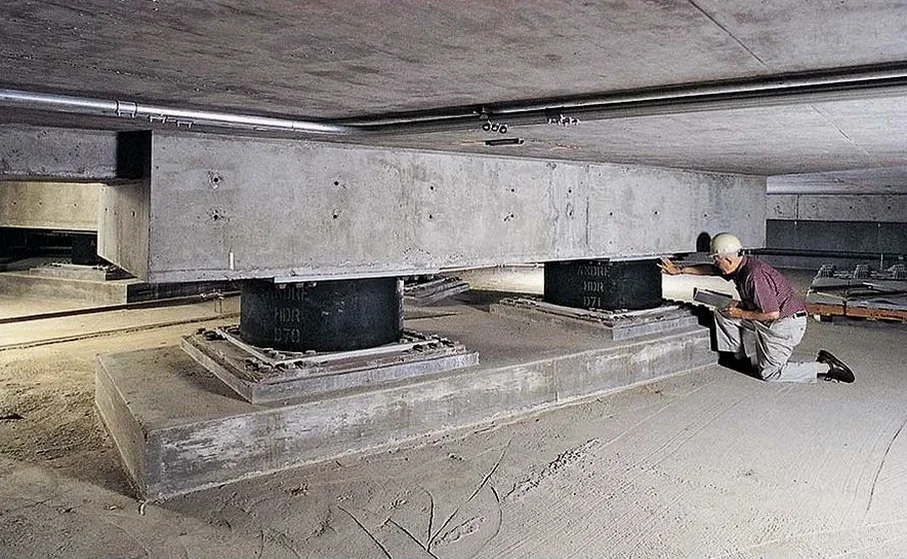
Here is what we often observe in the field around Nanaimo: older commercial buildings being retrofitted with base isolation on shallow foundations that were never designed for the eccentric loads and large overturning moments an isolation system introduces. The soil under the footing—sometimes a stiff glacial till, other times a weathered sandstone—can creep under sustained eccentric load, leading to differential settlement that binds the moat covers and locks the bearings. We also see retrofit projects where the isolation plane is installed above a basement level, and the designers underestimate the soil pressures on the retaining walls during the design earthquake displacement. A retaining wall that moves 400 mm into the backfill during the MCE sees passive pressures far exceeding at-rest values, and if that is not accounted for in the estabilidad de taludes or wall design, you get structural damage at the isolation interface. We flag these risks early in the design process because fixing a locked isolator after construction is exponentially more expensive than getting the geotechnical-structural interface right from the start.
Our services
Our base isolation design service in Nanaimo covers the full spectrum from geotechnical investigation through nonlinear structural analysis and peer review. Every project starts with understanding the soil—because the isolators sit on the foundation, and the foundation sits on the ground.
Site-Specific Seismic Hazard & Isolation Design
Complete design package including probabilistic seismic hazard analysis (PSHA), site response analysis for soft soil amplification, ground motion selection and scaling, nonlinear time-history analysis of the isolated structure, bearing specification (LRB, HDRB, friction pendulum), moat detail design, and peer review documentation for City of Nanaimo building permit submissions.
Geotechnical Investigation for Isolation Retrofit
Field investigation program for existing buildings undergoing seismic upgrade with base isolation. Includes SPT drilling to assess foundation soils, MASW or downhole seismic for Vs profile, laboratory testing for dynamic soil properties (strain-dependent modulus and damping), and foundation capacity assessment under the increased demands from the isolation system.
Quick answers
Does NBCC 2020 require base isolation for new buildings in Nanaimo?
No, base isolation is not mandatory. NBCC 2020 allows conventional fixed-base design for most building types. However, for post-disaster buildings, hospitals, emergency response facilities, and high-importance structures, base isolation is often the most cost-effective way to meet the enhanced performance objectives—typically immediate occupancy after the design earthquake. We help clients evaluate the cost-benefit based on their specific site and building function.
How much does a base isolation design package cost for a typical Nanaimo project?
For a complete design package covering site-specific hazard analysis, ground motion selection, nonlinear time-history analysis, bearing specification, and peer review coordination, the fee typically ranges from CA$6,520 to CA$11,510 depending on building size, structural complexity, and the extent of supplemental geotechnical investigation required. A detailed proposal is provided after an initial project review.
What soil conditions in Nanaimo are problematic for base isolation?
The main concerns are deep soft clay deposits (found in some low-lying areas near the estuary), liquefiable sands (mapped in parts of the Nanaimo lowlands), and sites with abrupt lateral changes in soil stiffness that can cause differential motion across the footprint. We also watch for sites underlain by the Cretaceous Nanaimo Group sandstone, which can have a highly variable weathering profile—competent rock at one end of the building and completely weathered material at the other.
What is the difference between lead-rubber and friction pendulum isolators for Vancouver Island seismicity?
Both systems work well, but the choice depends on the building period and the spectral shape. Lead-rubber bearings (LRB) carry out good energy dissipation through hysteretic damping and are simpler to install. Friction pendulum systems (FPS) offer a longer effective period and can handle larger displacements, which is beneficial for the long-period energy from Cascadia subduction events. We make the recommendation based on nonlinear time-history results using records that capture the magnitude 8–9 subduction scenarios that dominate the hazard in Nanaimo.