Nanaimo sits on a complex mix of Vashon glacial till and thick deposits of fine-grained marine silts and clays, particularly in the downtown core and near the Departure Bay shoreline. The geology here doesn’t forgive assumptions. When a tunnel alignment runs through saturated, low-strength ground with a water table sitting barely two meters below grade, the margin for error disappears. More than 90,000 people rely on infrastructure that crosses these formations daily, and any new bore—whether for utilities, transit, or combined operations—demands a ground model built on real data, not textbook generalizations. Our team handles the full investigation cycle: from exploratory drilling and undisturbed sampling to advanced lab testing, all calibrated to the specific stress history of Vancouver Island’s east-coast sediments. For deeper alignments where bedrock contact is uncertain, we combine downhole surveys with seismic refraction to map the till-bedrock interface before the TBM ever arrives on site.
Sensitive clays in Nanaimo lose up to 80% of their undisturbed shear strength when remolded—face pressure control isn’t optional, it’s the primary safety system.
Technical details of the service in Nanaimo
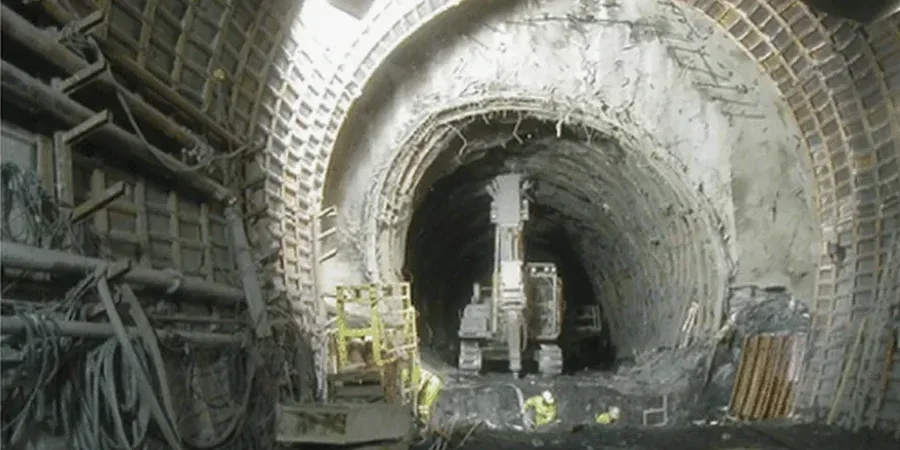
Risks and considerations in Nanaimo
The contrast between Nanaimo’s wet winter months and relatively dry summers creates a groundwater regime that can swing pore pressures by 15 to 20 kPa seasonally within the upper 10 meters. That fluctuation is enough to destabilize a tunnel face in low-Su soils if the pre-construction model assumes steady-state conditions. We’ve seen projects on the mid-island where an unanticipated perched aquifer delayed excavation by weeks because the original investigation stopped at six meters. In soft ground, the investigation must go deeper than the invert—at least two tunnel diameters below—to capture any underdrainage or artesian influence. Another risk tied directly to the region is seismicity: Nanaimo sits in a zone where a deep megathrust event could induce cyclic softening, even in materials not strictly classed as liquefiable. Our analysis includes post-earthquake shear strength reduction factors per the most recent NBCC seismic provisions, ensuring the lining design accounts for the ground’s degraded state after a major shake.
Our services
We take a phased approach to soft ground tunnel analysis in Nanaimo, moving from regional geology to lab-derived constitutive parameters to construction-phase monitoring:
Site investigation and drilling
Rotary mud drilling with Shelby tube sampling at tunnel depth, plus cone penetration testing for continuous stratigraphic profiling in soft clays.
Advanced laboratory testing
Triaxial CIU and CAU tests, oedometer swelling and consolidation, grain size distribution by hydrometer, and Atterberg limits on all cohesive samples.
Numerical modeling
2D and 3D finite-element simulations of staged excavation, face support pressure optimization, and settlement trough analysis for adjacent structures.
Construction-phase instrumentation
Inclinometers, piezometers, and surface settlement points with automated data collection, feeding back into the model for real-time parameter refinement.
Quick answers
What’s the biggest challenge when tunneling in Nanaimo’s soft ground?
The high sensitivity of the marine clays. When disturbed by excavation or water inflow, these soils can lose most of their strength, leading to face instability and larger-than-expected settlement. We quantify sensitivity early through lab testing so the TBM parameters are matched to the real ground behavior.
How deep do you investigate for a soft ground tunnel?
At minimum, two tunnel diameters below the invert. In Nanaimo, where perched aquifers and artesian conditions appear in glacial interbeds, we often extend the investigation deeper to rule out underdrainage that could destabilize the face during excavation.
How do you account for seismic risk in the tunnel lining design?
We apply post-earthquake shear strength reduction factors from the NBCC 2020 seismic provisions. For Nanaimo’s sensitive clays, we model the degraded ground state after a design-level event and design the lining to withstand the increased loading from the softened surrounding soil.
What does a typical soft ground tunnel analysis cost in Nanaimo?
Depending on the alignment length, depth, and number of boreholes required, a complete geotechnical analysis for a soft ground tunnel in Nanaimo ranges from CA$6,000 to CA$22,540. The scope includes drilling, undisturbed sampling, lab testing, and the numerical ground model.