The National Building Code of Canada (NBCC) sets clear performance requirements for foundations on compressible ground, and nowhere on Vancouver Island is this more critical than in Nanaimo. The city sits on a complex mix of Cretaceous sandstone, glacial till, and pockets of soft estuarine silt left by the Nanaimo River delta. Traditional shallow footings often fall short here. The solution in many cases is a stone column design that reinforces the weak matrix directly, creating composite ground with the bearing capacity to support multi-storey structures. Our technical team approaches each Nanaimo project by first reviewing the site stratigraphy, then determining whether CPT testing should supplement the borehole data to map the extent of the soft layers. This integrated method avoids overdesign and keeps the improvement zone precisely where it is needed, a discipline that separates a code-compliant job from a textbook exercise.
A well-designed stone column grid in Nanaimo's marine silts can double or triple the bearing capacity without the excavation and disposal costs of full soil replacement.
Technical details of the service in Nanaimo
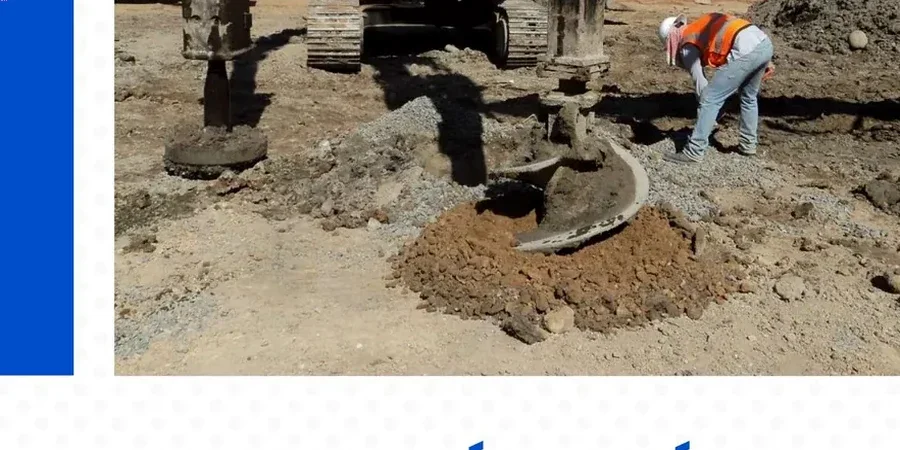
Live process video
Risks and considerations in Nanaimo
Nanaimo sits in Seismic Zone 4 per the NBCC 2020 seismic hazard maps, with a peak ground acceleration that demands careful consideration of liquefaction and cyclic softening in the city's waterfront fills. The magnitude 6.8 earthquake of 1946 that shook central Vancouver Island is a reminder that the ground under this city must be prepared for strong shaking. Stone column design in Nanaimo addresses two hazards simultaneously: static bearing failure and earthquake-induced settlement. The columns function as vertical drains during shaking, dissipating excess pore pressure before it can trigger liquefaction in loose silty layers. For sites within 500 meters of the Nanaimo Harbour shoreline, we typically specify a closer column spacing and require post-installation verification through a combination of CPT soundings and cross-hole shear wave measurements to confirm the densification effect has reached the design target across the full treatment depth.
Our services
Stone column design in Nanaimo is rarely a standalone discipline. The intervention must be coordinated with the broader geotechnical investigation and structural framing decisions. These are the core operations that typically accompany the design package.
Vibro-replacement design package
Complete design report including column grid layout, area replacement ratio calculations, aggregate specification, quality control testing plan, and construction monitoring protocol specific to Nanaimo's variable soil profile and seismic demands.
Post-installation verification
On-site load testing and CPT profiling to confirm the as-built stone columns meet the design modulus and settlement criteria. Includes report with comparison to pre-treatment conditions and sign-off by the responsible engineer.
Quick answers
What is the typical cost range for a stone column design in Nanaimo?
For a site-specific design package covering up to 150 columns, the engineering fee typically ranges from CA$2,220 to CA$7,070. The cost depends on the required depth of investigation, the complexity of the soil profile, and the number of verification tests included in the scope.
How does stone column design differ from vibrocompaction in Nanaimo?
Vibrocompaction densifies granular soils by rearranging particles, while stone columns actually replace a portion of the soft matrix with a stronger material. In Nanaimo, where we encounter cohesive marine clays that cannot be densified by vibration alone, stone columns are the correct choice. Vibrocompaction is generally only suitable for the loose sands found in some upland areas of the city.
Which aggregate is specified for stone columns in this region?
The specification usually calls for clean, angular crushed stone graded between 25 mm and 75 mm, meeting CSA A23.2 requirements. In Nanaimo, the aggregate must be free of fines because the wet installation method relies on clean drainage paths. Local quarries on the island generally supply suitable material, which helps keep freight costs manageable.
Can stone columns be installed close to existing structures in downtown Nanaimo?
Yes, but it requires careful sequencing. The lateral displacement during column installation can affect adjacent footings or buried utilities. We typically model the installation sequence and specify a minimum setback from existing foundations, often 1.5 to 2.0 meters, depending on the soil sensitivity. A pre-condition survey of the adjacent structures is mandatory.
How long does the design process take for a typical Nanaimo project?
From the completion of the geotechnical investigation to the delivery of the final stamped design package, the process usually takes three to four weeks. This includes the analytical modeling, internal peer review, and coordination with the structural engineer to ensure the improved ground parameters are correctly reflected in the foundation design.