Watching a six-storey mixed-use project rise on a confined lot near Port Drive, you quickly learn that Nanaimo’s glacial till and marine clay don’t behave like textbook soils. Our team has been called in when standard penetration data wasn’t enough to convince the structural reviewer that the foundation system would hold under earthquake loading. That’s where the triaxial test becomes non-negotiable. We run consolidated-undrained (CU), consolidated-drained (CD), and unconsolidated-undrained (UU) programs to isolate friction angle and cohesion under the exact confinement the soil will expertise at depth. For a city with 90,000 residents spread across sandstone benches and harbourfront fill, getting shear strength wrong isn’t just a budget risk — it’s a safety failure waiting to happen. Every sample we receive from Nanaimo drillers gets logged against the National Building Code of Canada (NBCC) and CSA A23.3, because in BC’s seismic zone, assumptions don’t stand up in court.
Shear strength measured under site-specific confining pressure eliminates the guesswork that inflates foundation costs in Nanaimo.
Technical details of the service in Nanaimo
Risks and considerations in Nanaimo
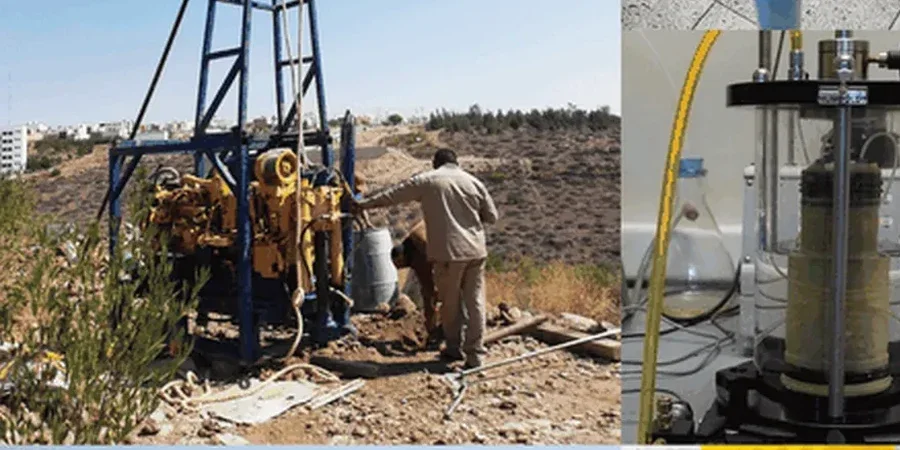
The triaxial cell sits inside a steel chamber rated for confining pressures that can exceed what the deepest basement excavation in Nanaimo would apply to a bearing stratum. A rubber membrane seals the cylindrical specimen, and de-aired water transmits the cell pressure while a load frame drives the piston downward at a controlled displacement rate. If the drainage valves are left open on a CU test when they should be closed, the entire failure envelope shifts and the reported cohesion becomes worthless. We’ve seen contractors lose weeks waiting for a second round of testing because the first lab didn’t saturate the clay properly — the Skempton B-value never reached 0.95, so effective stress calculations were junk. On a hillside project near VIU, that mistake nearly led to a retaining wall design with a factor of safety below 1.0. Triaxial testing without rigorous technique is just expensive theatre.
Our services
The triaxial program is never a standalone item — it integrates with the site investigation workflow that starts at the drill rig and ends with the foundation recommendation letter.
Consolidated-Undrained (CU) with Pore Pressure
The standard for short-term loading analysis in saturated clays. We measure excess pore pressure throughout shear so the engineer can compute effective stress strength parameters for undrained stability cases.
Consolidated-Drained (CD) Testing
Required for long-term slope stability and free-draining materials. Shearing is slow enough that pore pressure dissipates, giving drained friction angles for residual strength assessment.
Unconsolidated-Undrained (UU) Screening
A rapid method for total stress strength on cohesive samples where in-situ water content must be preserved. Useful for preliminary bearing capacity checks on tight schedules.
Advanced Stress Path Triaxial
For complex loading scenarios — staged excavation, embankment loading, seismic simulation — where the failure envelope alone isn’t sufficient to validate a finite element model.
Quick answers
How much does a triaxial test cost in Nanaimo?
Triaxial testing in Nanaimo typically ranges from CA$2,730 to CA$3,480 for a three-specimen set, depending on whether you need CU, CD, or UU protocols. Coarse-grained samples requiring larger 70 mm diameter specimens push toward the upper end. The price includes saturation, consolidation, shear, and the interpreted failure envelope with Mohr-Coulomb parameters. We recommend budgeting for at least two sets when the stratigraphy includes both fill and native till.
How long does a triaxial test program take?
A standard CU triaxial set with three confining pressures takes 7 to 10 working days from sample receipt to final report. CD tests run longer because the shear stage is much slower — plan 14 to 18 days. If the soil needs recomposition from a proctor curve, add 3 days for specimen preparation. Rush service can compress timelines to 5 days for CU when the project schedule demands it.
Which triaxial test type do I need for my Nanaimo site?
That depends on the loading case and drainage conditions. For short-term bearing capacity in clay, CU with pore pressure measurement is the standard. For slopes and long-term stability, CD tests give drained parameters. UU is a screening tool for total stress strength when the schedule is tight. We’ll review your borehole logs and project requirements to specify the right protocol before cutting a single specimen.
Do you pick up samples from the drill site in Nanaimo?
We coordinate directly with your drilling contractor and can arrange sample pickup across Nanaimo — from downtown sites near the harbour to projects in Cedar or Extension. Shelby tubes must be transported upright, protected from vibration and temperature extremes. Our field kit includes wax and plastic caps if the driller needs backup supplies on site.
What quality control do you follow during triaxial testing?
Every test series follows ASTM D4767 or D7181 procedures with full documentation of back-pressure saturation (minimum B-value 0.95), consolidation time, strain rate selection, and failure criteria. We run daily transducer calibrations and maintain an ISO 17025-accredited lab environment. The final report includes stress-strain curves, p-q diagrams, and pore pressure evolution so the reviewing engineer can verify every calculation. More info.